Key: When we see Jesus as our King, the natural next step is to burst forth in praise!
- God’s Greatness, vv. 1-7
- We Have a Great God!
- God is worthy of Great Praise
- God’s Kingdom, vv. 8-14
- The Character of the King, vv. 8-9
- The Characteristics of His Kingdom, vv. 10-14
- God’s People, vv. 15-21
- God Cares for His People, vv. 15-20
- God’s People Respond with Prayer and Praise, vv. 18-21
Dear God, Thank you for Psalm 145. And thank you for this book of Psalms. Thank you for these ladies who are listening and learning to love the Psalms with us. Would you teach us to praise Your name today… give us Your wisdom and cause us to fear you and to love you and to praise you. We pray these things in Jesus’ name, Amen.
Psalm 145 has got to be one of the greatest psalms of praise in the whole book! We often think of Psalms as a book of praises, but today’s psalm is actually the only one with the word “Praise” in its superscript title! Last time I was up here, we were talking about the darkest psalm in the Psalter…and today we’re on the exact opposite end of the spectrum, with one of the brightest psalms!
2020 has been quite the year. We’ve lived through (or maybe I should say we’re living through) a pandemic and protests [fires in California; hurricanes, tornadoes, Sahara dust–anyone else start counting to see if we were going to get to 10 plagues this year?! I wish I was joking]. And we’ve had enough politics to last a lifetime–or at least another four years. Tonight we find out who our next president is, but today, we get to focus on Psalm 145 and praising the King of Kings! And tomorrow, when we wake up with whatever results in our nation, we still get to praise the King of Kings!
In my opinion, Psalm 145 is one of the most beautifully complex pieces of poetry in the whole book of Psalms. And in some ways, rightly so. All that’s left is the closing five psalms, which are thought of as a set; Psalms 146-150 are one continuous doxological praise reflecting the same scheme as 145, starting with I will extol and ending with all flesh/breath praising the Lord; they move from individual praise to universal.
Intro / Structure
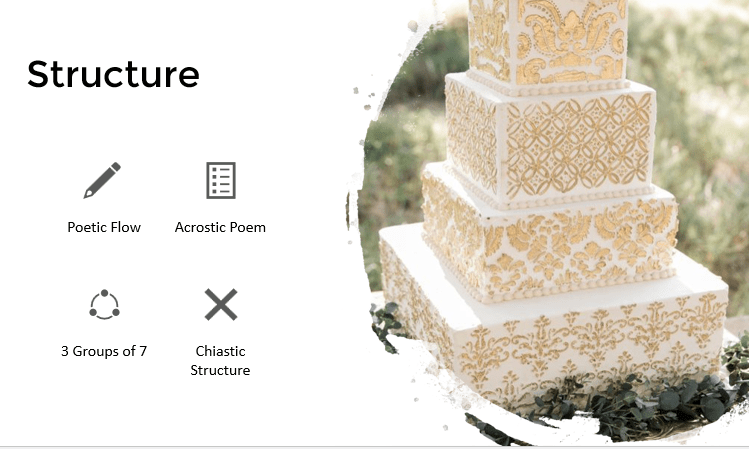
A few years ago, we got invited to an absolutely gorgeous wedding of some dear friends! It was the most beautiful, elaborate, glamorous event I will probably ever get invited to. And every detail was thoughtfully put together and perfectly executed. It took place in this beautiful old stone church in Laurens and then we went back to the family estate where a gigantic tent was setup in the lawn with live music, a full sit down dinner, fresh flowers and lights everywhere, and the most gorgeous cake I’ve ever laid eyes on. Have you ever been to a party like that?! Well, I know this analogy will crumble at some point, but Psalm 145 is like a stunning, tiered wedding cake. It has layers upon layers of structure…it’s sweet and specially crafted for the most glorious party you’ll ever go to!
1. The first layer is a classic vanilla–its face value structure: this psalm is beautiful as it is in its natural poetic flow. You could break it apart into various attributes of God and it’s almost a symphony of praise–David is so full of praise for God that he just can’t contain himself and it comes bursting forth like praise fireworks; he HAS to tell the world and the coming generations all about this great God! But it doesn’t stop there…
2. The second layer–pick your favorite flavor–is that this psalm is an acrostic poem: each verse starts with a new letter of the Hebrew alphabet. Now, there are several acrostics in the book of Psalms. It’s interesting to note that the acrostic psalms only appear in Books I and V, helping God’s people remember key truths as they open and close the Psalter.
In book I, we have Psalms 9 and 10 combined to form one acrostic poem; then there are Psalms 25, 34, and 37. In book V, Psalms 111 and 112 are both acrostics: Psalm 111 proclaims Who God is and Psalm 112 proclaims who God’s people are; and they’re considered a pair because they are strikingly similar (and it’s no mistake that they follow one of the most well-known Messianic Psalms, Psalm 110). And we have the most famous one–Psalm 119, which has a whole stanza for each Hebrew letter. Psalm 119 shows up right between a set of Hallel (or praise) psalms (a group known as the Psalms of Ascent). And finally, we have today’s psalm–Psalm 145. And guess what comes right before it? Psalm 144 is a Messianic Psalm too. When we see Jesus as our King, the natural next step is to burst forth in praise.
3. Now, our psalm today is considered an incomplete acrostic because it’s “missing” a letter in some manuscripts (nun, other manuscripts add this one back in, like our ESV translation). But it may have been intentionally left out; the fact that the majority don’t include it leaves us with 3 sets of 7, 7 being the number of completeness or perfection, so this Psalm, closes out the greater book of Psalms as a perfect praise to the glories of God.
4. And finally, we have a decadent chocolate layer–a chiastic structure (that X structure).
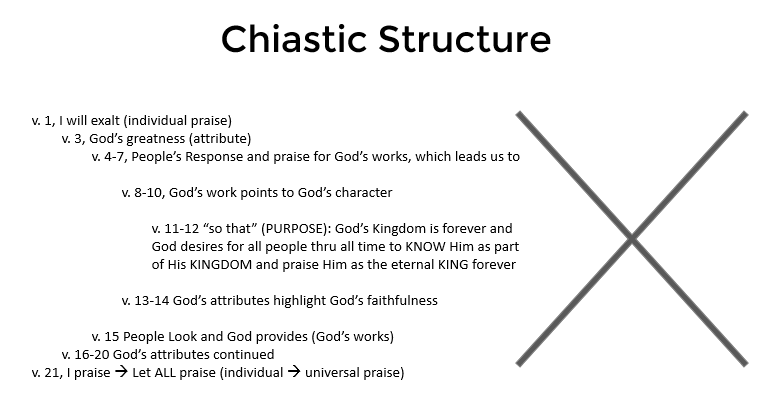
- At the beginning and end, we have praise for God,
- Then we move in a few verses and see some of God’s attributes;
- Move in a little more and we see God’s works and provision;
- Then more of God’s attributes and how His works point to His character;
- and right in the center, v. 11-12, we have a Purpose Statement — “to” or “so that”
- to make known to everyone that God’s Kingdom is forever and God desires for all people thru all time to KNOW Him as part of His KINGDOM and praise him as the eternal KING forever.
You can’t tell me this wasn’t inspired because there is no earthly poet that could have that many layers of structure turn out so beautifully.
For simplicity, we’re going to stick with the 3 groups of 7. We’ll look at God’s Greatness, God’s Kingdom, and God’s People. As we look at the first set of 7 verses, we see a repeated word/idea: Great, greatly, and greatness. This is where we get our first point:
I. God’s Greatness, vv. 1-7
As part of our homeschool curriculum, we’ve been working on some catechisms as a family. Do you remember the very first question in the Westminster Catechism? “What is the chief end of man?” The answer: “Man’s chief end is to glorify God and to enjoy Him forever.” Right… So, “How can you glorify God?” “By loving him and doing what he commands.” And “Where do you learn how to love and obey God?” “In the Bible alone.” So, God made us to glorify Him and enjoy Him forever. And He gave us His Word to know how! So let’s look at His Word today…
I. A. We Have a Great God!
“I will extol [exalt, NIV] you, my God and King, and bless your name forever and ever. Every day I will bless you and praise your name forever and ever” (vv. 1-2).
Before we go further, I want to point out the words “I” and “my”–this is personal praise. David has a personal relationship with the God of heaven and he calls Him “my God” [Elohim, God Almighty]–this shows a humility of spirit; then he calls Him “my King”–this shows submission–when the king of Israel tells the whole world, “God is my King” and I will bless His name “every day” for all eternity–“forever and ever”–this is noteworthy!
And the beauty is that it’s not just for David. This psalm was written down and preserved for all of God’s children to sing and claim. We can have this same personal relationship with Jesus as our King today and praise Him every day … forever and ever! Infinite praise to an infinite God! How well do I praise God? What am I doing to enhance my worship of Him? Well, in order to praise Him, we need to know Him. So let’s find out who this God King is and why we should praise Him. David begins to gush with what he’s come to know about his God: namely, He is great!
“Great is the Lord, and greatly to be praised, and his greatness is unsearchable” (v. 3).
Notice what name he uses for God here: the LORD (all caps)–YHWH, the Savior! He’s talking about Jesus. And the greatness of this Savior God is unfathomable–we cannot comprehend it! And yet, we make our life’s work to endeavor to do just that–to understand and know Jesus!
I. B. God is Worthy of Great Praise!
And as we begin to see his greatness, what happens? Keep reading in v. 4. And I want you to notice the little word “shall.”
“One generation shall commend your works to another, and shall declare your mighty acts” (v. 4).
It’s not that they “should” but that they “will.” When we are so consumed with the greatness of God, it will naturally spill forth into our conversation and relationships–with our friends, our families, your kids or grandkids, your students, the person in front of you at the grocery store…. Especially our families and close friends know what we think is great! Why? Because whether we try to keep it in or not, it comes up when we’re talking. It’s like finding the perfect Christmas for your best friend three months before Christmas–are you going to be able to keep it a surprise?! I mean, I’m not, it’s going to spill out at some point!
This psalm was likely written near the end of David’s life; he had a long, personal relationship with God, and he couldn’t help but pass it on. God commands His people to teach and obey His Law with the purpose of fearing the Lord. We’ve been talking about this all semester: “The fear of the Lord is the beginning of wisdom.” When we fear God, we begin to walk in wisdom and obedience to His Word. And when we do this, we begin to love God, and that love begins to grow until it consumes “all” of our heart, soul and might; then that consuming love begins to overflow, and we begin to talk about it when we sit and walk and lie down and rise (Deut. 6, right). The fear of the Lord, seeing the greatness of our God, is on our hearts and on our minds, and on our lips! And one day leads to the next and the next, until we are praising God “every day” “forever and ever!”
Do we love God in a way that spills over into “every day” “forever and ever!”? Are the children that we influence catching our admiration and adoration for the “greatness of God”? What do they think we love most? Do they see our love for good food or a good book or good TV series or favorite hobby or activity…our phones? What are we most passionate about? Is it God? Let’s let that be our aim! To Fear God and Love God and His Word so much that it spills out every day forever and ever!
Serving in our children’s ministry has actually helped grow this in me. Especially in the preschool ages, there is natural wonder and curiosity about everything! And it’s contagious! So, as I work to put gospel truths onto a 3-5 year old level of understanding, I find their childlike awe and wonder reigniting in my heart too. And by God’s grace, the more I practice it, the more natural it becomes. Don’t let anyone tell you that wonder and awe is only for kids and it’s something you grow out of! You can totally grow in wonder and awe, no matter what age you are, especially when it has to do with God and His Word!
So, we know our aim. To Fear God and Love God and His Word so much that it spills out every day forever and ever! How do we get there? Well, I’m glad you asked.
“On the glorious splendor of your majesty, and on your wondrous works, I will meditate. They shall speak of the might of your awesome deeds, and I will declare your greatness. They shall pour forth [celebrate, NIV] the fame of your abundant goodness and shall sing aloud of your righteousness“ (vv. 5-7).
And we’re back to Psalm 1:1-2, “Blessed is the man…whose delight is in the law of the LORD, and on His law he meditates day and night!”
Notice what David says he’s meditating on here: “your majesty,” “your greatness,” “your abundant goodness”–this is Who God Is, God’s Person or Character; then “your wondrous works,” “your awesome deeds,” “your righteousness”–this is What God Does, His Word and Work in creating and redeeming His people.
And how does David meditate? He “speaks” and “declares”–he’s rehearsing the gospel to himself! Then he celebrates with joyful singing–music and movement. God made us to move and speak and sing–and every detail of His creation is so that we can glorify Him!
This past month for school, we were learning the “Star Spangled Banner,” so we talked about why we celebrate our independence with fireworks and watched a couple kid history videos; and I was moved to tears! It was Sept. 13, 1814, the Battle of Baltimore in the War of 1812. Sir Francis Scott Key was sent to negotiate the release of American soldiers from the British. But after they had negotiated an exchange, they informed him it wouldn’t matter because their entire fleet was going to lay siege on Fort McHenry that night. And they wouldn’t let him get back to the fort to warn the Americans. He had to sit there, waiting and watching the “rocket’s red glare, the bombs bursting in air” (the original “fireworks” show) to see if the flag was still waving. See, all the Americans had to do was take down the American flag and wave the British one, but they wouldn’t do it. At the end of the night, the flag was at an angle–it was torn to shreds but it hadn’t touched the ground. It was still waving! And this is the part that hit me–the only thing keeping it in the air were the bodies of the soldiers propping it up by the sacrifice of their own lives. Their freedom–our freedom–was that important to them! And it drove a lawyer to write a song that would become our national anthem!
Application: If we’ve trusted Christ as our Savior, the flag of Zion flies in our hearts because Jesus sacrificed his very life, fighting every enemy, and Psalm 145 is the song that becomes our anthem of praise as citizens of the Heavenly Kingdom, as praise to our true King! Galatians 5:1 says, “For freedom Christ has set us free; stand firm therefore, and do not submit again to a yoke of slavery.” We no longer serve Satan and sin; we are free in Christ because of His sacrifice! And it causes us to sing His praises!
And what is the song we sing for eternity? Revelation 15:3, “And they sing…the song of the Lamb, saying, “Great and amazing are your deeds, O Lord God the Almighty! Just and true are your ways, O King of the nations!” God is great! And greatly to be praised! For Who He is and what He does! He is incomprehensible, and yet He is absolutely worthy of our thoughts.
How can we meditate on the glorious splendor and wondrous works of God? How has God made Himself known or proven Himself praiseworthy to you this week? Since we’re talking about acrostics, I actually found myself lying in bed one night this week and working my way through the alphabet as I prayed and thanked God for his character traits, His works, answers to prayer. I had a wise friend back in college encourage me to keep a 3-ring binder of all of God’s attributes in alphabetical order and as I found verses that mentioned those attributes to write it out. It was a way to prepare for those dark nights of the soul like we talked about with Psalm 88. When those hard times comes (as we all know they will), I’m able to pull out that old binder and have reminders of Who God is so I can preach the gospel to myself again and again just by reading and meditating through my journal of verses. And when we meditate on him, what is the result: praise! We tell, commend, speak, proclaim, celebrate, and joyfully sing of God’s greatness!
Next, we’ll look at the Kingdom of this Great King. We’ll see the Character of the King as well as the characteristics of His Kingdom.
II. God’s Kingdom, vv. 8-14
II. A. Character of the King, vv. 8-9
“The Lord is gracious and merciful (compassionate), slow to anger and abounding in steadfast love (covenant faithfulness). The Lord is good to all, and his mercy is over all that he has made“ (vv. 8-9).
In these two short verses, we have a summary of Who God is from Creation (“all that he made”) to Consummation. And this isn’t the only time we’ve seen these attributes grouped together, is it? This group is found together all throughout Scripture, but the first time this grouping is expressed is by God Himself in Exodus 34, and it’s a response to Moses’ bold request. Moses asked to see God’s glory in Ex. 33:18, and what does God do? He hides Moses in the cleft of a rock, passes by, and reveals this description of Himself for the first time. And when Moses comes down from Mt. Sinai, he’s still glowing with God’s glory, even though he barely saw a glimmer of it! Moses’ face was so bright, the people couldn’t look at him without a veil over his face! Wow! Show me that glory! And if you kept reading, you saw that not only did God proclaim His glorious name, He made a two-fold promise: to forgive His people, and also to punish the guilty. And Moses’ response? Exodus 34: 8, “And Moses quickly bowed his head toward the earth and worshiped.” Then he repented for himself and on behalf of the people and pleaded that God would “take us for Your inheritance.” And God did. God called them His people–and He calls us the same. God promised to be their God forever and ever, and the character and promise that He revealed to Moses that day hasn’t changed and never will.
When we repent and believe and trust Him as our Lord and King, He welcomes us into His Kingdom! Before we go on to talk about God’s Kingdom, can I make an invitation? Whether you’re new to church or have gone your whole life, if you’ve never personally seen God as glorious and repented of your sin and asked Him to rescue you and save you, would you do that today? If you have questions about that, please find a gospel preaching church near you. Let a true follower of the King sit down and share more of who this God is and how you can have a personal relationship with Him forever! God loves you so much, and He wants you to be part of His Kingdom!
II. B. Characteristics of His Kingdom, vv. 10-13
II. B. 1. God’s Kingdom is Glorious
“All your works shall give thanks to you, O Lord, and all your saints shall bless you! They shall speak of the glory of your kingdom and tell of your power, to* make known to the children of man your mighty deeds, and the glorious splendor of your kingdom“ (vv. 10-12). * [“to”(ESV) is a purpose statement; in the NIV: “so that all people may know of your mighty acts and the glorious splendor of your kingdom.” — All people of all time Know the King of the greatest Kingdom!]
What is the Glory of God’s Kingdom? Glory is “something that secures very great praise, a distinguished honor, or worshipful exaltation.” This is basically the sum of all of God’s attributes! And it literally radiates from Him (like we talked about with Exodus!) God has secured great praise because of his works in Creation and in Redemption (remember Psalm 19), and He is worthy of worshipful exaltation because of His sovereign eternal reign. Revelation gives us a glimpse of this: “Worthy are you, our Lord and God, to receive glory and honor and power, for you created all things, and by your will they existed and were created.” (Creation; 4:11) And “Worthy is the Lamb who was slain, to receive power and wealth and wisdom and might and honor and glory and blessing!” (Redemption; 5:12). God’s Kingdom is full of glory because God Himself is glorious! Revelation 15:8 says, “and the sanctuary was filled with smoke from the glory of God and from his power….”
God Kingdom is Glorious…and
II. B. 2. God’s Kingdom is Eternal
“Your kingdom is an everlasting kingdom, and your dominion endures throughout all generations. [The Lord is faithful in all his words and kind (faithful, NIV) in all his works.]” (v. 13).
Every word of God is true. He is trustworthy in all He promises; faithful in everything He says and does. God made a covenant with King David in 2 Sam. 7, and He intends to keep it! David recognizes this and rejoices in it!
Do you recognize God’s covenant promise and rejoice in God’s eternal reign? If we’re submitting to God as our Sovereign King, if we’ve trusted Jesus as our Savior and Lord, then, while there may be a level of fear or dreadful awe in our souls, it should also comfort and thrill our hearts that we’ll get to be part of His glorious, eternal kingdom, as citizens with the privilege of serving and praising God forever! Let’s pray that we will stand in awe and bow in praise to this amazing King!
“The Lord upholds all who are falling and raises up all who are bowed down” (v. 14).
We looked at several psalms that talked about falling or “sinking down” (Ps. 66, 88, 130…) Do you feel like you’re falling? God upholds “all who are falling”–all–this isn’t just for believers; this is a general mercy for all of God’s creation; He upholds you by the power of His breath–that same breath that breathed into existence the whole universe is upholding it!
When you get this glimpse of God’s glory, do you bow down? Does it cause you to fall down in humility and worship? This reminds me of James 4, where it says, “God … gives grace to the humble.” He calls us to “Submit ….and draw near to God;” to “Resist the devil, and repent….” to “Humble yourselves before the Lord,” and then what does He promise? “He will draw near to you; … and he will exalt you.” When we humble ourselves and submit to God as King, God raises us up with Christ and turns our mourning into laughter. We are united with Christ in salvation and that union is eternal; it doesn’t go away. We get to sit together with Jesus in the New Heaven and New Earth, as co-heirs exercising dominion alongside Christ, our King.
In this final stanza, we’ll see God’s People–and we want to look at two different perspectives: God towards mankind (in His Care) and Man towards God (as they respond in praise). We’ll save the final verse for the end, but let’s read vv. 15-20 and point out these two perspectives as we go.
III. God’s People, vv. 15-21
“The eyes of all look to you, and you give them their food in due season” (v. 15). We look to God; we long for Him; our souls thirst for Him, and what does He do? He provides; our needs are met. Remember Ps. 105, as the Israelites sojourned in the wilderness and God gave them just the right amount of food that they needed at just the right time? “They asked, and he brought them quail; He fed them well with the bread of heaven and opened the rock, and water gushed out; flowing like a river in the desert.”
“You open your hand; you satisfy the desire of every living thing” (v. 16). He’s generous and freely gives us good gifts; again, this is a universal mercy here, raining on the just and the unjust.
“The Lord is righteous in all his ways and kind in all his works” (v. 17). He’s just; perfectly right; He doesn’t make mistakes. He is merciful, showing steadfast love.
“The Lord is near to all who call on him, to all who call on him in truth” (v. 18). The Lord is close by; at hand when we pray. We’ll come back to this verse in a minute.
“He fulfills the desire of those who fear him” (v. 19a). In fact, He Himself is the Desire of Nations; notice the audience is narrowing; it’s not universal anymore, but those who fear or reverence Him. And what does He do? “He also hears their cry and saves them” (v. 19b). We saw this cry for help or deliverance in Ps. 66 and 130, and there is hope, because–look what He does–He listens and rescues us!
Then he closes the book of Psalms by going back to where it all began. In one verse, he summarizes Psalms 1 and 2: “The Lord preserves all who love him, but all the wicked he will destroy” (v. 20). Remember Ps. 66 and Psalm 1? What do we love or cherish in our hearts? Our sin? Or our Savior?
III. A. God Cares for His People
Once again, you could break this apart into Who God Is (His Person) and What God Does (His Works):
1. Who God Is: Righteous and Kind and Near [“near”: this is the same word used to describe the kinsman-redeemer; it’s the next of kin, and he’s waiting, ready, and able to meet the redemptive need. The kindness of v. 17 is on display and grows through v. 18-20a. Even the destruction of the wicked can be a good thing for those who are being saved from them (see “Wrath” note from NIV Study Bible).
2. What God Does: if you include v. 14 from the last section, He upholds all who are falling, raises up all who are bowed down; gives food, opens His hand, satisfies the desire of every living thing, hears, saves, preserves, and even destroys the wicked. Again, He is listening, and He is able and ready to fully and completely rescue His people! He fulfills our desire for a curse-crusher by sending us His Son, Jesus. He hears and he saves! He is listening…and He is near! He is a Good and Great King to ALL who call!
III. B. God’s People Respond with Prayer and Praise
What key words do we see here? What do God’s people do? They “look” to Him…and they’re “satisfied.” Do we do this? How do you see God providing for you? Have you seen Him satisfy your desires–maybe not by giving you what you think you want, but by changing your desires and making your desires for “His will to be done on earth as it is in Heaven”?
What else do they do? They “call” or “cry” to God 3x here. Note that phrase in v.18: “in truth” — this is someone who sees and begins to understand the truth about God–that He is King and He is in control. God is not our personal genie to be summoned to grant our wishes, but rather we are His servants and His children, and we cry out for help–for a Rescuer–and He is near, like a parent waiting outside the room (only He knows exactly when to let us keep crying and when to pick us up and allow us to rest and sleep in His arms).
And then in vv. 19-20, they “fear Him” and they “love him.” When we are properly fearing the Lord, we cry out and repent and ask Him to make us His own. And the longer we look on Jesus, the deeper we love Him. So, keep looking! Don’t let the world distract you; don’t let your sinful desires tempt you; keep looking to Jesus; and I promise you He will satisfy every longing of your heart, here now and forever in heaven.
How do we look to Jesus? We’ve come full-circle… by “meditating on His Law, day and night.” Just like Psalm 1 was the gatekeeper to the “temple” that is the Psalter, Psalm 145 feels like we’re standing on the threshold of Zion, and we’re about to enter into eternal praise. Even so, come, Lord Jesus!
Let’s look at our final verse: David’s conclusion and closing doxology.
“My mouth will speak the praise of the Lord, and let all flesh bless his holy name forever and ever” (v. 21).
The word “all” or “every” is used 19x in Psalm 145! We’re part of that “all flesh”–so let’s be part of the answers to David’s prayer of praise and bless the Holy Name of King Jesus today and every day, forever and ever!
How will all flesh bless his name? They have to hear it and see it lived out. We meditate on the law, we obey it, and the people around us see it. Deut. 4 showed us that the people of God were meant to show forth Who God Is to the surrounding nations; God would use His people to draw all peoples and nations into the covenant too. In Deuteronomy 4:6, Moses reminds the people of God to “Keep [the commandments they’d been taught] and do them, for that will be your wisdom and your understanding in the sight of the peoples, who, when they hear all these statutes, will say, ‘Surely this great nation [referring to Israel or God’s Kingdom, which we are part of His covenant people as believers in Jesus] is a wise and understanding people.’ For what great nation is there that has a god so near to it as the Lord our God is to us, whenever we call upon him? And what great nation is there, that has statutes and rules so righteous as all this law that I set before you today?”
Fast forward to the New Testament and just before Jesus ascended into Heaven after his resurrection, He told His disciples in Matthew 28 to go out and tell all nations that Jesus is King! Matthew 28:19-20 says, “Go … and make disciples of all nations, baptizing them … [and] , teaching them to observe all that I have commanded you. And behold, I am with you always, to the end of the age.” Once again, we have commands and a God who is near! And in Philippians 2, we know that David’s prayer will be answered, because we read “that at the name of Jesus every knee should bow, in heaven and on earth and under the earth, 11 and every tongue confess that Jesus Christ is Lord, to the glory of God the Father.”
God is great; His kingdom is glorious and eternal; He is full of goodness and grace, and as we meditate on Who He Is and What He Does, we must–we shall–respond in praise and gratitude and obedience. The more you know someone and love someone, the more you can’t help telling everyone about him. WE MUST KNOW KING JESUS AND MAKE HIM KNOWN!
Dear God, Thank you for the book of Psalms. Thank You for this semester of slowing down and finding true gems in your Word. Help us as we seek to know You and to make You known today and for eternity. Show us Your great and mighty works, Your eternal kingdom, Your complete care and tune our hearts to sing Your praise now and forever. “Now to the King of the ages, immortal, invisible, our Savior and Lord, Jesus Christ, who is the blessed and only Sovereign God, the King of kings and Lord of lords, who dwells in unapproachable light, whom no one has ever seen or can see. To Him be honor and glory and eternal dominion forever and ever.” In His Name we pray, Amen.
For Further Study: Read the following passages. How does each one help you understand this Psalm better?
- Exodus 34:6-7
- Deuteronomy 4:7; 6:1-9
- Daniel 7:13-14
- 1 Timothy 1:15-17; 6:15-16
- Revelation 15:3
 Word-Filled Women