Psalm 145: A Song of Praise to the King

Key: When we see Jesus as our King, the natural next step is to burst forth in praise!

  1. God’s Greatness, vv. 1-7
    • We Have a Great God!
    • God is worthy of Great Praise
  2. God’s Kingdom, vv. 8-14
    • The Character of the King, vv. 8-9
    • The Characteristics of His Kingdom, vv. 10-14
  3. God’s People, vv. 15-21
    • God Cares for His People, vv. 15-20
    • God’s People Respond with Prayer and Praise, vv. 18-21

Dear God, Thank you for Psalm 145. And thank you for this book of Psalms. Thank you for these ladies who are listening and learning to love the Psalms with us. Would you teach us to praise Your name today… give us Your wisdom and cause us to fear you and to love you and to praise you. We pray these things in Jesus’ name, Amen.

Psalm 145 has got to be one of the greatest psalms of praise in the whole book! We often think of Psalms as a book of praises, but today’s psalm is actually the only one with the word “Praise” in its superscript title! Last time I was up here, we were talking about the darkest psalm in the Psalter…and today we’re on the exact opposite end of the spectrum, with one of the brightest psalms!

2020 has been quite the year. We’ve lived through (or maybe I should say we’re living through) a pandemic and protests [fires in California; hurricanes, tornadoes, Sahara dust–anyone else start counting to see if we were going to get to 10 plagues this year?! I wish I was joking]. And we’ve had enough politics to last a lifetime–or at least another four years. Tonight we find out who our next president is, but today, we get to focus on Psalm 145 and praising the King of Kings! And tomorrow, when we wake up with whatever results in our nation, we still get to praise the King of Kings!

In my opinion, Psalm 145 is one of the most beautifully complex pieces of poetry in the whole book of Psalms. And in some ways, rightly so. All that’s left is the closing five psalms, which are thought of as a set; Psalms 146-150 are one continuous doxological praise reflecting the same scheme as 145, starting with I will extol and ending with all flesh/breath praising the Lord; they move from individual praise to universal.

Intro / Structure
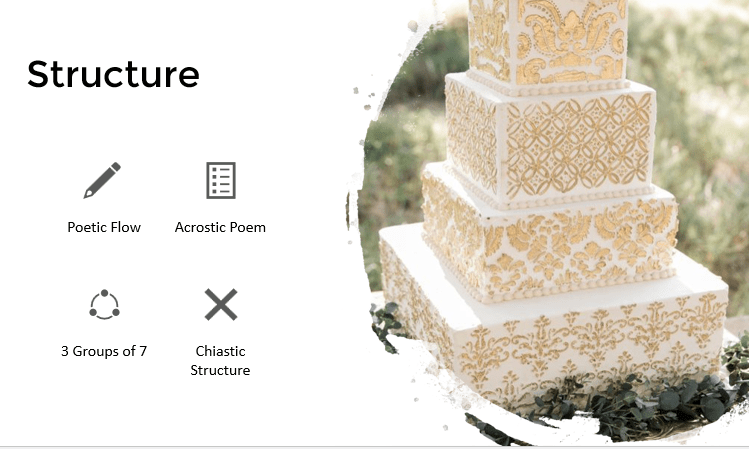
A few years ago, we got invited to an absolutely gorgeous wedding of some dear friends! It was the most beautiful, elaborate, glamorous event I will probably ever get invited to. And every detail was thoughtfully put together and perfectly executed. It took place in this beautiful old stone church in Laurens and then we went back to the family estate where a gigantic tent was setup in the lawn with live music, a full sit down dinner, fresh flowers and lights everywhere, and the most gorgeous cake I’ve ever laid eyes on. Have you ever been to a party like that?! Well, I know this analogy will crumble at some point, but Psalm 145 is like a stunning, tiered wedding cake. It has layers upon layers of structure…it’s sweet and specially crafted for the most glorious party you’ll ever go to!

1. The first layer is a classic vanilla–its face value structure: this psalm is beautiful as it is in its natural poetic flow. You could break it apart into various attributes of God and it’s almost a symphony of praise–David is so full of praise for God that he just can’t contain himself and it comes bursting forth like praise fireworks; he HAS to tell the world and the coming generations all about this great God!  But it doesn’t stop there…

2. The second layer–pick your favorite flavor–is that this psalm is an acrostic poem: each verse starts with a new letter of the Hebrew alphabet. Now, there are several acrostics in the book of Psalms. It’s interesting to note that the acrostic psalms only appear in Books I and V, helping God’s people remember key truths as they open and close the Psalter.

In book I, we have Psalms 9 and 10 combined to form one acrostic poem; then there are Psalms 25, 34, and 37. In book V, Psalms 111 and 112 are both acrostics: Psalm 111 proclaims Who God is and Psalm 112 proclaims who God’s people are; and they’re considered a pair because they are strikingly similar (and it’s no mistake that they follow one of the most well-known Messianic Psalms, Psalm 110). And we have the most famous one–Psalm 119, which has a whole stanza for each Hebrew letter. Psalm 119 shows up right between a set of Hallel (or praise) psalms (a group known as the Psalms of Ascent). And finally, we have today’s psalm–Psalm 145. And guess what comes right before it? Psalm 144 is a Messianic Psalm too. When we see Jesus as our King, the natural next step is to burst forth in praise.

3. Now, our psalm today is considered an incomplete acrostic because it’s “missing” a letter in some manuscripts (nun, other manuscripts add this one back in, like our ESV translation). But it may have been intentionally left out; the fact that the majority don’t include it leaves us with 3 sets of 7, 7 being the number of completeness or perfection, so this Psalm, closes out the greater book of Psalms as a perfect praise to the glories of God.

4. And finally, we have a decadent chocolate layer–a chiastic structure (that X structure).
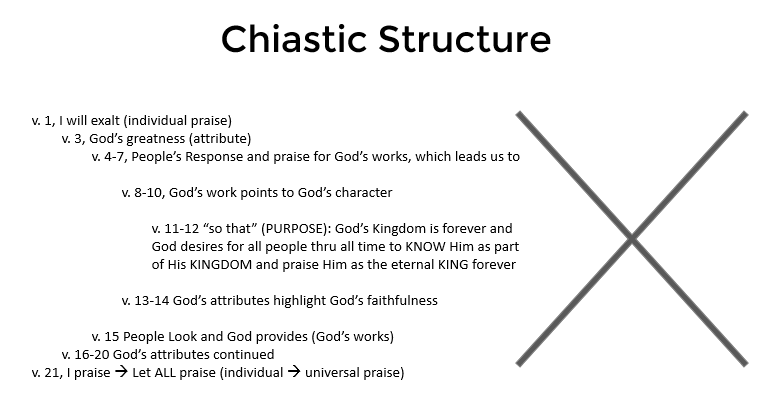
  • At the beginning and end, we have praise for God,
  • Then we move in a few verses and see some of God’s attributes;
  • Move in a little more and we see God’s works and provision;
  • Then more of God’s attributes and how His works point to His character;
  • and right in the center, v. 11-12, we have a Purpose Statement — “to” or “so that”
  • to make known to everyone that God’s Kingdom is forever and God desires for all people thru all time to KNOW Him as part of His KINGDOM and praise him as the eternal KING forever.

You can’t tell me this wasn’t inspired because there is no earthly poet that could have that many layers of structure turn out so beautifully.

For simplicity, we’re going to stick with the 3 groups of 7.  We’ll look at God’s Greatness, God’s Kingdom, and God’s People. As we look at the first set of 7 verses, we see a repeated word/idea: Great, greatly, and greatness. This is where we get our first point:

I. God’s Greatness, vv. 1-7

As part of our homeschool curriculum, we’ve been working on some catechisms as a family. Do you remember the very first question in the Westminster Catechism? “What is the chief end of man?” The answer: “Man’s chief end is to glorify God and to enjoy Him forever.” Right… So,  “How can you glorify God?” “By loving him and doing what he commands.” And “Where do you learn how to love and obey God?” “In the Bible alone.”  So, God made us to glorify Him and enjoy Him forever. And He gave us His Word to know how! So let’s look at His Word today…

I. A. We Have a Great God!

“I will extol [exalt, NIV] you, my God and King, and bless your name forever and ever. Every day I will bless you and praise your name forever and ever” (vv. 1-2).

Before we go further, I want to point out the words “I” and “my”–this is personal praise. David has a personal relationship with the God of heaven and he calls Him “my God” [Elohim, God Almighty]–this shows a humility of spirit; then he calls Him “my King”–this shows submission–when the king of Israel tells the whole world, “God is my King” and I will bless His name “every day” for all eternity–“forever and ever”–this is noteworthy!

And the beauty is that it’s not just for David. This psalm was written down and preserved for all of God’s children to sing and claim. We can have this same personal relationship with Jesus as our King today and praise Him every day … forever and ever! Infinite praise to an infinite God! How well do I praise God? What am I doing to enhance my worship of Him? Well, in order to praise Him, we need to know Him. So let’s find out who this God King is and why we should praise Him. David begins to gush with what he’s come to know about his God: namely, He is great!

Great is the Lord, and greatly to be praised, and his greatness is unsearchable” (v. 3).

Notice what name he uses for God here: the LORD (all caps)–YHWH, the Savior! He’s talking about Jesus. And the greatness of this Savior God is unfathomable–we cannot comprehend it! And yet, we make our life’s work to endeavor to do just that–to understand and know Jesus!

I. B. God is Worthy of Great Praise!

And as we begin to see his greatness, what happens? Keep reading in v. 4. And I want you to notice the little word “shall.”

“One generation shall commend your works to another, and shall declare your mighty acts” (v. 4).

It’s not that they “should” but that they “will.” When we are so consumed with the greatness of God, it will naturally spill forth into our conversation and relationships–with our friends, our families, your kids or grandkids, your students, the person in front of you at the grocery store…. Especially our families and close friends know what we think is great! Why? Because whether we try to keep it in or not, it comes up when we’re talking. It’s like finding the perfect Christmas for your best friend three months before Christmas–are you going to be able to keep it a surprise?! I mean, I’m not, it’s going to spill out at some point!

This psalm was likely written near the end of David’s life; he had a long, personal relationship with God, and he couldn’t help but pass it on. God commands His people to teach and obey His Law with the purpose of fearing the Lord. We’ve been talking about this all semester: “The fear of the Lord is the beginning of wisdom.” When we fear God, we begin to walk in wisdom and obedience to His Word. And when we do this, we begin to love God, and that love begins to grow until it consumes “all” of our heart, soul and might; then that consuming love begins to overflow, and we begin to talk about it when we sit and walk and lie down and rise (Deut. 6, right). The fear of the Lord, seeing the greatness of our God, is on our hearts and on our minds, and on our lips! And one day leads to the next and the next, until we are praising God “every day” “forever and ever!”

Do we love God in a way that spills over into “every day” “forever and ever!”? Are the children that we influence catching our admiration and adoration for the “greatness of God”? What do they think we love most? Do they see our love for good food or a good book or good TV series or favorite hobby or activity…our phones? What are we most passionate about? Is it God? Let’s let that be our aim! To Fear God and Love God and His Word so much that it spills out every day forever and ever!

Serving in our children’s ministry has actually helped grow this in me. Especially in the preschool ages, there is natural wonder and curiosity about everything! And it’s contagious! So, as I work to put gospel truths onto a 3-5 year old level of understanding, I find their childlike awe and wonder reigniting in my heart too. And by God’s grace, the more I practice it, the more natural it becomes. Don’t let anyone tell you that wonder and awe is only for kids and it’s something you grow out of! You can totally grow in wonder and awe, no matter what age you are, especially when it has to do with God and His Word!

So, we know our aim. To Fear God and Love God and His Word so much that it spills out every day forever and ever! How do we get there? Well, I’m glad you asked.

“On the glorious splendor of your majesty, and on your wondrous works, I will meditate. They shall speak of the might of your awesome deeds, and I will declare your greatness. They shall pour forth [celebrate, NIV] the fame of your abundant goodness and shall sing aloud of your righteousness (vv. 5-7).

And we’re back to Psalm 1:1-2, “Blessed is the man…whose delight is in the law of the LORD, and on His law he meditates day and night!”

Notice what David says he’s meditating on here: “your majesty,” “your greatness,” “your abundant goodness”–this is Who God Is, God’s Person or Character; then “your wondrous works,” “your awesome deeds,” “your righteousness”–this is What God Does, His Word and Work in creating and redeeming His people.

And how does David meditate? He “speaks” and “declares”–he’s rehearsing the gospel to himself! Then he celebrates with joyful singing–music and movement. God made us to move and speak and sing–and every detail of His creation is so that we can glorify Him!

This past month for school, we were learning the “Star Spangled Banner,” so we talked about why we celebrate our independence with fireworks and watched a couple kid history videos; and I was moved to tears! It was Sept. 13, 1814, the Battle of Baltimore in the War of 1812. Sir Francis Scott Key was sent to negotiate the release of American soldiers from the British. But after they had negotiated an exchange, they informed him it wouldn’t matter because their entire fleet was going to lay siege on Fort McHenry that night. And they wouldn’t let him get back to the fort to warn the Americans. He had to sit there, waiting and watching the “rocket’s red glare, the bombs bursting in air” (the original “fireworks” show) to see if the flag was still waving. See, all the Americans had to do was take down the American flag and wave the British one, but they wouldn’t do it. At the end of the night, the flag was at an angle–it was torn to shreds but it hadn’t touched the ground. It was still waving! And this is the part that hit me–the only thing keeping it in the air were the bodies of the soldiers propping it up by the sacrifice of their own lives. Their freedom–our freedom–was that important to them! And it drove a lawyer to write a song that would become our national anthem! 

Application: If we’ve trusted Christ as our Savior, the flag of Zion flies in our hearts because Jesus sacrificed his very life, fighting every enemy, and Psalm 145 is the song that becomes our anthem of praise as citizens of the Heavenly Kingdom, as praise to our true King! Galatians 5:1 says, “For freedom Christ has set us free; stand firm therefore, and do not submit again to a yoke of slavery.” We no longer serve Satan and sin; we are free in Christ because of His sacrifice! And it causes us to sing His praises!

And what is the song we sing for eternity? Revelation 15:3, “And they sing…the song of the Lamb, saying, “Great and amazing are your deeds, O Lord God the Almighty! Just and true are your ways, O King of the nations! God is great! And greatly to be praised! For Who He is and what He does! He is incomprehensible, and yet He is absolutely worthy of our thoughts.

How can we meditate on the glorious splendor and wondrous works of God? How has God made Himself known or proven Himself praiseworthy to you this week? Since we’re talking about acrostics, I actually found myself lying in bed one night this week and working my way through the alphabet as I prayed and thanked God for his character traits, His works, answers to prayer. I had a wise friend back in college encourage me to keep a 3-ring binder of all of God’s attributes in alphabetical order and as I found verses that mentioned those attributes to write it out. It was a way to prepare for those dark nights of the soul like we talked about with Psalm 88. When those hard times comes (as we all know they will), I’m able to pull out that old binder and have reminders of Who God is so I can preach the gospel to myself again and again just by reading and meditating through my journal of verses. And when we meditate on him, what is the result: praise! We tell, commend, speak, proclaim, celebrate, and joyfully sing of God’s greatness!

Next, we’ll look at the Kingdom of this Great King. We’ll see the Character of the King as well as the characteristics of His Kingdom.

II. God’s Kingdom, vv. 8-14

II. A. Character of the King, vv. 8-9

“The Lord is gracious and merciful (compassionate), slow to anger and abounding in steadfast love (covenant faithfulness). The Lord is good to all, and his mercy is over all that he has made (vv. 8-9).

In these two short verses, we have a summary of Who God is from Creation (“all that he made”) to Consummation. And this isn’t the only time we’ve seen these attributes grouped together, is it? This group is found together all throughout Scripture, but the first time this grouping is expressed is by God Himself in Exodus 34, and it’s a response to Moses’ bold request. Moses asked to see God’s glory in Ex. 33:18, and what does God do? He hides Moses in the cleft of a rock, passes by, and reveals this description of Himself for the first time. And when Moses comes down from Mt. Sinai, he’s still glowing with God’s glory, even though he barely saw a glimmer of it! Moses’ face was so bright, the people couldn’t look at him without a veil over his face! Wow! Show me that glory! And if you kept reading, you saw that not only did God proclaim His glorious name, He made a two-fold promise: to forgive His people, and also to punish the guilty. And Moses’ response? Exodus 34: 8, “And Moses quickly bowed his head toward the earth and worshiped.” Then he repented for himself and on behalf of the people and pleaded that God would “take us for Your inheritance.” And God did. God called them His people–and He calls us the same. God promised to be their God forever and ever, and the character and promise that He revealed to Moses that day hasn’t changed and never will.

When we repent and believe and trust Him as our Lord and King, He welcomes us into His Kingdom! Before we go on to talk about God’s Kingdom, can I make an invitation? Whether you’re new to church or have gone your whole life, if you’ve never personally seen God as glorious and repented of your sin and asked Him to rescue you and save you, would you do that today? If you have questions about that, please find a gospel preaching church near you. Let a true follower of the King sit down and share more of who this God is and how you can have a personal relationship with Him forever! God loves you so much, and He wants you to be part of His Kingdom!

II. B. Characteristics of His Kingdom, vv. 10-13

II. B. 1. God’s Kingdom is Glorious

“All your works shall give thanks to you, O Lord, and all your saints shall bless you! They shall speak of the glory of your kingdom and tell of your power,  to* make known to the children of man your mighty deeds, and the glorious splendor of your kingdom (vv. 10-12). * [“to”(ESV) is a purpose statement; in the NIV: “so that all people may know of your mighty acts and the glorious splendor of your kingdom.” — All people of all time Know the King of the greatest Kingdom!]

What is the Glory of God’s Kingdom? Glory is “something that secures very great praise, a distinguished honor, or worshipful exaltation.” This is basically the sum of all of God’s attributes! And it literally radiates from Him (like we talked about with Exodus!) God has secured great praise because of his works in Creation and in Redemption (remember Psalm 19), and He is worthy of worshipful exaltation because of His sovereign eternal reign. Revelation gives us a glimpse of this: “Worthy are you, our Lord and God, to receive glory and honor and power, for you created all things, and by your will they existed and were created.” (Creation; 4:11) And “Worthy is the Lamb who was slain, to receive power and wealth and wisdom and might and honor and glory and blessing!” (Redemption; 5:12). God’s Kingdom is full of glory because God Himself is glorious! Revelation 15:8 says, “and the sanctuary was filled with smoke from the glory of God and from his power….”

God Kingdom is Glorious…and

II. B. 2. God’s Kingdom is Eternal

“Your kingdom is an everlasting kingdom, and your dominion endures throughout all generations. [The Lord is faithful in all his words and kind (faithful, NIV) in all his works.]” (v. 13).

Every word of God is true. He is trustworthy in all He promises; faithful in everything He says and does. God made a covenant with King David in 2 Sam. 7, and He intends to keep it! David recognizes this and rejoices in it!

Do you recognize God’s covenant promise and rejoice in God’s eternal reign? If we’re submitting to God as our Sovereign King, if we’ve trusted Jesus as our Savior and Lord, then, while there may be a level of fear or dreadful awe in our souls, it should also comfort and thrill our hearts that we’ll get to be part of His glorious, eternal kingdom, as citizens with the privilege of serving and praising God forever! Let’s pray that we will stand in awe and bow in praise to this amazing King!

“The Lord upholds all who are falling and raises up all who are bowed down” (v. 14).

We looked at several psalms that talked about falling or “sinking down” (Ps. 66, 88, 130…) Do you feel like you’re falling? God upholds “all who are falling”–all–this isn’t just for believers; this is a general mercy for all of God’s creation; He upholds you by the power of His breath–that same breath that breathed into existence the whole universe is upholding it!

When you get this glimpse of God’s glory, do you bow down? Does it cause you to fall down in humility and worship? This reminds me of James 4, where it says, “God … gives grace to the humble.” He calls us to “Submit ….and draw near to God;” to “Resist the devil, and repent….” to “Humble yourselves before the Lord,” and then what does He promise? “He will draw near to you; … and he will exalt you.” When we humble ourselves and submit to God as King, God raises us up with Christ and turns our mourning into laughter. We are united with Christ in salvation and that union is eternal; it doesn’t go away. We get to sit together with Jesus in the New Heaven and New Earth, as co-heirs exercising dominion alongside Christ, our King.

In this final stanza, we’ll see God’s People–and we want to look at two different perspectives: God towards mankind (in His Care) and Man towards God (as they respond in praise). We’ll save the final verse for the end, but let’s read vv. 15-20 and point out these two perspectives as we go.

III.  God’s People, vv. 15-21

“The eyes of all look to you, and you give them their food in due season” (v. 15). We look to God; we long for Him; our souls thirst for Him, and what does He do? He provides; our needs are met. Remember Ps. 105, as the Israelites sojourned in the wilderness and God gave them just the right amount of food that they needed at just the right time? “They asked, and he brought them quail; He fed them well with the bread of heaven and opened the rock, and water gushed out; flowing like a river in the desert.”

“You open your hand; you satisfy the desire of every living thing” (v. 16). He’s generous and freely gives us good gifts; again, this is a universal mercy here, raining on the just and the unjust.

“The Lord is righteous in all his ways and kind in all his works” (v. 17). He’s just; perfectly right; He doesn’t make mistakes. He is merciful, showing steadfast love.

The Lord is near to all who call on him, to all who call on him in truth” (v. 18). The Lord is close by; at hand when we pray. We’ll come back to this verse in a minute.

“He fulfills the desire of those who fear him” (v. 19a). In fact, He Himself is the Desire of Nations; notice the audience is narrowing; it’s not universal anymore, but those who fear or reverence Him. And what does He do? “He also hears their cry and saves them” (v. 19b). We saw this cry for help or deliverance in Ps. 66 and 130, and there is hope, because–look what He does–He listens and rescues us!

Then he closes the book of Psalms by going back to where it all began. In one verse, he summarizes Psalms 1 and 2: “The Lord preserves all who love him, but all the wicked he will destroy” (v. 20). Remember Ps. 66 and Psalm 1? What do we love or cherish in our hearts? Our sin? Or our Savior?

III. A. God Cares for His People 

Once again, you could break this apart into Who God Is (His Person) and What God Does (His Works):

1. Who God Is: Righteous and Kind and Near [“near”: this is the same word used to describe the kinsman-redeemer; it’s the next of kin, and he’s waiting, ready, and able to meet the redemptive need. The kindness of v. 17 is on display and grows through v. 18-20a. Even the destruction of the wicked can be a good thing for those who are being saved from them (see “Wrath” note from NIV Study Bible).

2. What God Does: if you include v. 14 from the last section, He upholds all who are falling, raises up all who are bowed down; gives food, opens His hand, satisfies the desire of every living thing, hears, saves, preserves, and even destroys the wicked. Again, He is listening, and He is able and ready to fully and completely rescue His people! He fulfills our desire for a curse-crusher by sending us His Son, Jesus. He hears and he saves! He is listening…and He is near! He is a Good and Great King to ALL who call!

III. B. God’s People Respond with Prayer and Praise

What key words do we see here? What do God’s people do? They “look” to Him…and they’re “satisfied.” Do we do this? How do you see God providing for you? Have you seen Him satisfy your desires–maybe not by giving you what you think you want, but by changing your desires and making your desires for “His will to be done on earth as it is in Heaven”?

What else do they do? They “call” or “cry” to God 3x here. Note that phrase in v.18: “in truth” — this is someone who sees and begins to understand the truth about God–that He is King and He is in control. God is not our personal genie to be summoned to grant our wishes, but rather we are His servants and His children, and we cry out for help–for a Rescuer–and He is near, like a parent waiting outside the room (only He knows exactly when to let us keep crying and when to pick us up and allow us to rest and sleep in His arms).

And then in vv. 19-20, they “fear Him” and they “love him.” When we are properly fearing the Lord, we cry out and repent and ask Him to make us His own. And the longer we look on Jesus, the deeper we love Him. So, keep looking! Don’t let the world distract you; don’t let your sinful desires tempt you; keep looking to Jesus; and I promise you He will satisfy every longing of your heart, here now and forever in heaven.

How do we look to Jesus? We’ve come full-circle… by “meditating on His Law, day and night.” Just like Psalm 1 was the gatekeeper to the “temple” that is the Psalter, Psalm 145 feels like we’re standing on the threshold of Zion, and we’re about to enter into eternal praise. Even so, come, Lord Jesus!

Let’s look at our final verse: David’s conclusion and closing doxology.

My mouth will speak the praise of the Lord, and let all flesh bless his holy name forever and ever” (v. 21).

The word “all” or “every” is used 19x in Psalm 145! We’re part of that “all flesh”–so let’s be part of the answers to David’s prayer of praise and bless the Holy Name of King Jesus today and every day, forever and ever!

How will all flesh bless his name? They have to hear it and see it lived out. We meditate on the law, we obey it, and the people around us see it. Deut. 4 showed us that the people of God were meant to show forth Who God Is to the surrounding nations; God would use His people to draw all peoples and nations into the covenant too. In Deuteronomy 4:6, Moses reminds the people of God to Keep [the commandments they’d been taught] and do them, for that will be your wisdom and your understanding in the sight of the peoples, who, when they hear all these statutes, will say, ‘Surely this great nation [referring to Israel or God’s Kingdom, which we are part of His covenant people as believers in Jesus] is a wise and understanding people.’ For what great nation is there that has a god so near to it as the Lord our God is to us, whenever we call upon him? And what great nation is there, that has statutes and rules so righteous as all this law that I set before you today?”

Fast forward to the New Testament and just before Jesus ascended into Heaven after his resurrection, He told His disciples in Matthew 28 to go out and tell all nations that Jesus is King! Matthew 28:19-20 says, “Go … and make disciples of all nations, baptizing them … [and] , teaching them to observe all that I have commanded you. And behold, I am with you always, to the end of the age.” Once again, we have commands and a God who is near! And in Philippians 2, we know that David’s prayer will be answered, because we read “that at the name of Jesus every knee should bow, in heaven and on earth and under the earth, 11 and every tongue confess that Jesus Christ is Lord, to the glory of God the Father.”

God is great; His kingdom is glorious and eternal; He is full of goodness and grace, and as we meditate on Who He Is and What He Does, we must–we shall–respond in praise and gratitude and obedience. The more you know someone and love someone, the more you can’t help telling everyone about him. WE MUST KNOW KING JESUS AND MAKE HIM KNOWN!

Dear God, Thank you for the book of Psalms. Thank You for this semester of slowing down and finding true gems in your Word. Help us as we seek to know You and to make You known today and for eternity. Show us Your great and mighty works, Your eternal kingdom, Your complete care and tune our hearts to sing Your praise now and forever. “Now to the King of the ages, immortal, invisible, our Savior and Lord, Jesus Christ, who is the blessed and only Sovereign God, the King of kings and Lord of lords, who dwells in unapproachable light, whom no one has ever seen or can see. To Him be honor and glory and eternal dominion forever and ever.” In His Name we pray, Amen.

For Further Study: Read the following passages. How does each one help you understand this Psalm better?

  • Exodus 34:6-7
  • Deuteronomy 4:7; 6:1-9
  • Daniel 7:13-14
  • 1 Timothy 1:15-17; 6:15-16
  • Revelation 15:3

Psalm 88: A Dark and Desperate Cry (Learning to Lament)

  1. Intro: A Look at Lament
  2. The Promise of God, v. 1a
  3. The Problem of Pain, v. 3-9a, 14-18
  4. The Prayer of Patience, v. 1-2, 9b, 13
  5. The Process to Praise, v. 10-12; Ps. 89:1ff

Dear God, This is a dark psalm. It is heavy and we need Your wisdom. Would You give us that wisdom and help us as we seek to properly express our griefs and sorrows to You. Thank You for giving us this example and help us to go away changed by our meditation on Your Word today. In Jesus’ Name, Amen.

Intro: A Look at Lament

Psalm 88 is one of the great Lament Psalms–and it’s actually known as the “darkest psalm in the Psalter.” In all seriousness, there is a beauty in learning to lament. As Anne Bradstreet wrote, “If we had no winter, the spring would not be so pleasant: if we did not sometimes taste of adversity, prosperity would not be so welcome.”

What is lament? Lament is some kind of passionate expression of grief or sorrow, a complaint or even anger, over a significant loss or something that seems unreasonable or unfair; it’s often set to music, like a funeral dirge, and it can include physical wailing and sobbing. It’s personal and private and might even be loud and emotionally messy. On top of this deep grief, we often experience some measure of guilt for complaining to God. But, as we’ve learned, OVER HALF of the Psalms are laments! So, it’s clearly something that God wants us to be able to use in responding to Him. But we’re not good at this, at least I’m not. So, I’m thankful that our psalmist today models how we as believers in God can take these big emotions and rightly relate them to God when we don’t know where to begin.

These last few months alone have been full of grief and disappointment. In Psalm 88, we have an example of how it’s not only appropriate but actually proper to express our deepest, darkest emotions to God. My goal for today is two-fold: 1. that you go away from this lecture knowing that God desperately loves you and longs to hear your deepest, darkest cries and bring you out on the other side to a place of praise and blessing and beauty; He does. And 2. that you have empathy for others who are in seasons of lament and learn to “weep with those who weep” (Romans 12:15).

So, personal side note here, I naturally tend more towards logic/administrative details and I’m really thankful how God is using this psalm to grow empathy in my own heart. It struck me that the Spirit was using His word to do this as I practiced this talk. This first time I read all the way through it, so many of your faces and stories flooded into my mind and heart and I literally cried the whole way through… So, know that God is working on your teachers’ hearts too and using His word to transform us…and know that you are very loved even when we can’t be in the same room.

At the beginning of Psalm 88, we have a bunch of Title Notes. These header notes have been included within the Psalter since it was compiled and are actually considered part of the inspired word of God. So, let’s start by looking at those.

A Song: It’s important to remember that the psalms are songs. Some of the best ways we can express our emotions is through music.
A Psalm of the Sons of Korah: so this was either by or for the temple musicians.
To the choirmaster: or another translation is “to dispose God to mercy.”
According to Mahalath Leannoth: literally, “sickness” “to humble or afflict.”
A Maskil: “to make wise.” This is “a psalm of understanding.”
Of (by) Heman(Hebrew: ןמיח HaYMahN) the Ezrahite (or Zerahite): whose name means ‘Faithful’. And we’ll see how he lives up to his name in this psalm. We know he’s a court musician, but there are a few court musicians with this name in the OT, so it’s hard to know exactly which one he is. And that’s okay.

In summary, Psalm 88 is a song for personal use when we are afflicted, to bring us humbly before God, and to help us understand how to beg God for mercy and faithfully pray to Him even in the midst of our hopeless feelings.

CONTEXT

We’re at the end of Book III, so over halfway through our Psalter. The first two books focused on God’s delivering his king–specifically, David, but as a foreshadowing of Jesus. Book III seems to correlate to the Exilic Period–the period where the nation of Israel had disobeyed and was punished by being exiles either in foreign lands or treated as exiles in their own land. We don’t know exactly when this Psalm was written, but it was either written during that exilic period OR if it was written during the time of David and Solomon’s reign, it still helps express the emotions that were felt during exile, so it’s well placed here in the larger book of Psalms.

If you look at Psalm 87 (the psalm before this one), the theme is “God will keep His covenant!” The psalmist is convinced of it! Then we go in to this dark, almost entirely hopeless lament in Psalm 88. Then, the last psalm of Book III is Psalm 89, and the psalmist is praising God but still lamenting as he waits for the covenant promises to be kept. So that gives us some context. Psalm 88’s as low as we go, so it’s all up hill from here.

Now, let’s look at our text: Psalm 88.

Notice who’s talking: There’s a lot of “I” or “my.” “The psalm is written in first person, but,” as Schreiner points out, “it speaks of the state of Israel: troubled, enervated, depressed, friendless, grieving and most of all separated from the Lord” (The King in His Beauty, p. 268). So it’s easy to apply this psalm to ourselves, but let’s not forget to put ourselves in the Israelites’ shoes as we read it too–a nation in exile waiting for their Messiah to appear.

There’s a lot of sporadic back and forth and then it ends…without really a resolution. When we’re experiencing these deep emotions, there’s often not a whole lot of order or logic in our expression of it, and I want you to know that that’s okay. The psalmist pings around a lot in this one, so I’ve grouped different verses together for an outline, but we’re going to walk straight through the text. I have four main categories: The Promise of God, The Problem of Pain, The Prayer of Patience, and The Process to Praise.

The Promise of God, v. 1a

We’ll see that the psalmist actually starts with where he wants to end. He states what he knows and wants to believe about God. We know that we should praise God, and we want to get to that point, but there are times when we just aren’t there. So how does Heman start?

“O LORD, God of my salvation” — All throughout Scripture, and especially in the Psalms, God promises to hear and to rescue His people, to save us. The psalmist calls God “LORD” (all caps, YHWH, Savior) and repeats it by making it personal: “God of MY salvation.” He knows that salvation belongs to the LORD. That’s the promise he’s clinging to. If you think about, isn’t that the story of the whole Bible? “Salvation belongs to the LORD.” That’s the promise we all have to cling to as we walk through these dark nights of the soul.

The Prayer of Patience, v. 1b-2

He prays. Weaved in and out of all of his declarations of complaints and griefs and sorrows is this perseverance of prayer. Let’s read the rest of verse 1, “I cry out day and night before you.” Write off the bat, we see a connection to Psalm 1. The psalmist cries out day and night, just like the Blessed One “meditates day and night.”

“Let my prayer come before you; incline your ear to my cry!” (v. 2).

He’s pleading with God, and then he lets us in on this raw, personal, cry that he utters to God in vv. 3-9.

The Problem of Pain, v. 3-9a

“For my soul is full of troubles, and my life draws near to Sheol [grave/ death]. I am counted among those who go down to the pit; I am a man who has no strength, like one set loose [“freed”] among the dead, like the slain that lie in the grave, like those whom you remember no more, for they are cut off from your hand” (vv. 3-5).

He’s surrounded by troubles from every side–troubles from within (v. 3), and then troubles from outside (vv. 4-5). He feels cut off from God, which would be truly hopeless. Think about it, he’s a temple musician and he can’t get to the temple. He compares living to praise and not-living to not-praising; he desires to live and praise God, but he feels like death might be freedom. Before we go further, I want to be sure to say that if you are feeling like this…like death might be better than the suffering you’re feeling, can I encourage you to seek professional help? We are complex creatures living in a fallen world. And while we are spiritual creatures, we also have bodies. God remembers that we are dust (even when we forget sometimes). And God made us to live in community, so please don’t try to walk this path alone. Reach out to one of us or to one of the pastors or elders or elders’ wives. You are not alone. You are loved by this church, and more importantly, by our good, good Father!

In this next section, we see the psalmist shift back and forth between “I”/“my” and “You”/“Your.” He’s blaming God for this deep, dark, overwhelming wrath and soul-crushing loneliness.

Is it okay to blame God for our troubles? In Alec Motyer’s Psalms devotional, he counseled his readers, “Don’t hesitate to see your trials as coming from the hand of God” (p. 248). If we are in God’s hand, “the trial only means that he grips us more tightly!” (p. 248). He goes on, “Don’t bother your head with problems arising, or thought to arise, from seeing things this way. [From seeing God as the cause of your pain.] This is the truth of the matter: if we are in the soup it is he who has decided what sort of soup it is, and at what temperature, and how long, and why! He is God” (p. 248). The weeping prophet, Jeremiah, agreed with him, affirming that God caused his grief, but reminding us of the promise that God will have compassion according to his abundant steadfast love.

“You have put me in the depths of the pit, in the regions dark and deep. Your wrath lies heavy upon me, [like a weight on your chest and you can’t breath] and you overwhelm me with all your waves” (vv. 6-7).

Judgment and wrath are often conveyed with sea or wave imagery in the Bible. Sometimes we feel legitimate wrath for sin that needs repentance; remember Jonah? And yet even there, God had a divine plan to rescue His servant. Sometimes the weight of God’s wrath is just there, and it has nothing to do with anything you’ve done; think about Noah when the whole world was judged by a flood; he felt the waves, but he was righteous. Do you feel like God is punishing you, but you can’t for the life of you figure out what you did wrong? If there’s sin, repent; but either way, waves are meant to draw us down and into the embrace of our Lord.

Then we get this little word off to the side. Selah [this would be a pause or rest in the music, and it’s like the psalmist is coming up out of the waves, gasping for air before the next wave hits.] Selah (deep breath)

“You have caused my companions to shun me; you have made me a horror to them. I am shut in so that I cannot escape [I can’t get out]” (v.8)

This is possibly a quarantine situation from a disease like leprosy…or I don’t know…another virus which shall not be named?? Anyone felt shut in or shunned recently? This psalm’s for you.

“My eye grows dim through sorrow [or “has languished through affliction]” (v. 9).

Have you been there? Do you feel alone, rejected by God and everyone else, for that matter? Do you feel like you’re trapped in a pit or in one of those Escape Room Adventures, but you have no one on your team and the timer’s gone off and no one’s letting you out? This is where the psalmist is. And what does he do with it? He prays again.

The Prayer of Patience, 9b

“Every day I call upon you, O LORD; I spread out my hands to you” (v.9b).

This faithful psalmist is faithful in prayer, and his example compels us to be faithful in prayer too, even when we’re overwhelmed with dark feelings and deep sorrow. And it’s not a quiet prayer, is it? It’s physical. He spreads out his hands towards God, and he begins to ask a series of 6 questions in vv. 10-14. It’s as if this finite man is making every effort to understand His infinite God. He’s trying to comprehend what God is doing, but God is incomprehensible.

The Process to Praise, v. 10-12

“Do you work wonders for the dead? Do the departed rise up to praise you? Selah [here he takes another breath] Is your steadfast love declared in the grave, or your faithfulness in Abaddon? [or literally, Destruction] Are your wonders known in the darkness, or your righteousness in the land of forgetfulness?” (vv.10-12).

Even in his questioning, he rehearses certain truths–he knows God does mighty wonders and is worthy of praise; he knows God is supposed to have steadfast love and faithfulness; he knows God’s wonders and righteousness are to be known. And yet he questions all of it!

Have you experienced this desperate cry? Have you ever questioned God like this? I’ve found myself here before–more times than I might like to admit. The first time I remember it was the loss of my great grandmother in the 4th grade; I was supposed to be singing with my class for the Senior Saints Luncheon, but I couldn’t bring myself to do it; and someone found me hiding in the bathroom, crying. It was the first close family member that I had experienced losing. Another time was when a friend died in a sudden, tragic accident when I was in college. Every time a wave of emotion or doubt would surge, I would fight it by repeating a phrase to myself, “God is good all the time. God is good all the time.” Over and over again in my head–and sometimes out loud–at least a hundred times a day for what felt like weeks or months, until I believed it again.

Have you felt groanings too deep for words? The shock of coworker who had been part of our young adult Bible study and had been to our house for dinner with his house on a Friday night, then on Monday morning, his wife called to see if he had come to work. She couldn’t get ahold of him, and come to find out we were the last people to see him alive. He was a veteran and lost his battle with PTSD, leaving those of us behind with feelings of unbearable grief, betrayal, disbelief, and more unanswerable questions than you can fathom.

Have your dreams been crushed? And you find yourself reeling between nearly every emotion known to man in 3-minute cycles till 3AM when you crash in exhaustion and there are no more tears and the only feeling left is numbness? I’ve been there. And those are just a few that I can share from my experience. Some of you have dealt with far worse than I. This psalm is for me, and this psalm is for you.

“Is your steadfast love declared in the grave, or your faithfulness in Destruction?” (v.11).

Let’s think about this for a minute. Can death declare love and faithfulness? I’d argue that it absolutely can! In fact, it did in the death of our Lord and Savior Jesus Christ. His death was the ultimate declaration of love and faithfulness! And in his death, our man of sorrows he took our griefs and carried our sins; he was crushed by the weight of God’s wrath because of me…and you…so that he could once and for all destroy death and heal our wounds, bringing us peace with God.

Another prayer: The Prayer of Patience

“But I, O LORD, cry to you; in the morning my prayer comes before you” (v. 13).

In the middle of his list of questions, he pauses to pray and remind God that he’s been faithful in prayer. In the midst of feelings of hopelessness, yet still he prays to the LORD (YHWH). He knows his only help is from God, and he desperately cries for a Savior.

Again, he lets us be a fly on the wall in this very vulnerable moment as he asks his last two questions in his process of learning to praise.

The Process to Praise

“O LORD, why do you cast my soul away? Why do you hide your face from me?” (v. 14).

The process to praise often includes questioning God… Do you remember the story of Job? Job had lost his children, his livelihood, and his health all in one day…his friends accused him and shunned him and his wife even suggested that he just curse God so that God would kill him. Instead, Job determined to bless God. But in the midst of that belief, we have a lengthy record of his back and forth with God–a back and forth that’s full of questions. And God patiently met him where He was and responded with questions, leading him to truth.

The Problem of Pain, v. 15-18

The psalmist continues to enumerate his woes. Again, he’s skipping between “I”/”my” and “You”/”Your” in v. 15 thru the end of the chapter.

“Afflicted and close to death from my youth up, “I suffer your terrors: I am helpless” (v. 15). These are ongoing struggles, maybe even lifelong ones.

Your wrath has swept over me; your dreadful assaults destroy me” (v. 16). This is a fierce wrath that flows over him like hot, fiery lava.

They surround me like a flood all day long; they close in on me together ” (v. 17). We just saw fire imagery, and now we see flood imagery again. One of my sources referred to this as “the prison of the heart.” He was trapped between fire and flood and unable to escape.

“You have caused my beloved and my friend to shun me; my companions have become darkness [lit., “darkness is my best friend”] (v. 18). The ones who you thought loved you the most have hurt you the most and abandoned you and you feel shame and oppression and loneliness and like the only one left to listen is darkness itself. Motyer calls this section “a climax of hopelessness” (p. 247).

Isaiah 50:10, “Who walks in darkness and has no light, let him trust in the name of the LORD, and lean upon his God.”

I’m reminded of a quote that Ken Collier often shares, “When there’s a gap between God’s ways and wisdom and our understanding of God’s ways and wisdom, we must fill the gap with trust.” How do we do this? By rehearsing God’s promises… And while we can’t choose our emotions, we can choose to persevere in prayer–and ask others to pray
that our emotions will follow and we will be able to trust that God is with us, guiding us and caring for us…even in the “valley of the shadow of death” (Ps. 23:4).

Let’s look again at The Prayers in our Psalm.

We have prayers in vv.1-2; and another right in the middle in v. 9; then v. 13 is almost identical to vv. 1-2.

Where else do we see patient, persistent prayer in Scripture? I think the greatest example is in our Lord’s life. He’s constantly going up to a mountain or off to some quiet spot to pour out his heart to the Father. In three of the Gospels [see Matt. 26, Mark 14, and Luke 22], we see Jesus in the Garden of Gethsemane, at the foot of the Mount of Olives, pleading with God. This is just before he’s betrayed by Judas (one of his 12 closest friends) and would be sentenced to death on the cross (one of the most painful, humiliating deaths ever). He is “deeply distressed and troubled,” “overwhelmed with sorrow to the point of death,” and “in anguish.” He prayed three times that God would take this cup of sorrow away (referring to his own death on the cross), but says, “Not my will but yours.” I found it interesting to note that Jesus prayed three times about the thorns that were literally about to pierce him, and in 2 Cor. 12, Paul prayed three times that God would remove his “thorn in his flesh,” calling it, “a messenger of Satan to torment me,” why? “to keep me from becoming conceited” and “so that the power of Christ may rest up on me.” And we also have three prayers in this psalm.

Three (3) is a significant number in Scripture; not only does it represent the Trinity, but it also symbolizes development or growth in an individual, especially through trials. Jesus brought three disciples with Him to the Garden to pray with Him–Peter, James, and John. He tells them to watch and pray as he goes a little further to pray alone; and in between His three prayers, He checks back in. What does He find each time? They’re asleep. They can’t stay awake. Luke tells us it’s because they’re “exhausted from sorrow.” Meanwhile, God sends an angel from heaven to strengthen Jesus as he prays, and it says, “he prayed the more earnestly, and his sweat was like drops of blood falling to the ground.” Sound like lament? Absolutely.

What if Psalm 88 was one of the psalms that Jesus prayed during those hours of prayer in the Garden or while He hung on the cross paying for our sins, mistreated, abused, rejected, alone in his darkest hour? We don’t know exactly what he prayed that night, but we do know that our Lord used the whole book of Psalms in his personal worship of God. Jesus used the Psalms as his personal prayer book on this earth. And not only did Jesus pay for our sins, bearing all of our sorrow and pain on his shoulders, Scripture tells us he makes intercession for us! Jesus prays for us!

Even in our groanings, we are not alone–“the whole creation has been groaning together” since the Curse. There will be horrible sufferings in this sin-cursed world, but we can be convinced that “nothing at all can ever separate us from the love of God in Christ Jesus our Lord.” His love IS steadfast!

The Process to Praise, Ps. 89:1

The Psalms lead us to this conclusion too. It is no coincidence that Psalm 89 follows Psalm 88; and it’s quite possible that the Ethan who wrote Psalm 89 is the biological brother to our psalmist, Heman, which is a pretty cool example of “brothers being born to help us in times of adversity.” Psalm 89 is still a lament, but there are glimmers of hope and praise and steadfast love.

Psalm 89:1 says, “I will sing of the steadfast love of the LORD, forever; with my mouth I will make known your faithfulness to all generations.”

In Isaiah 38, we see that the prophet records a writing of Hezekiah king of Judah. Remember, he was the king who had been really sick and then restored to life for a certain period of years. Well, Hezekiah prayed a prayer really similar to Psalm 88. He talks about “walk[ing] slowly all [his] years because of the bitterness of [his] soul” (15). Then, he cries to God and begs, “O Lord, restore me to health and make me live!” (16). Then the beautiful part comes. He says in v. 17, “Behold, it was for my welfare [Look! It was for my own good!] that I had great bitterness; but in love you have delivered my life from the pit of destruction, for you have cast all my sins behind your back.” God’s love really is steadfast and full of deliverance! God is abundant in mercy!

Like Hezekiah and Heman and Paul, we groan in these earthly bodies. We lament. “We walk by faith, not by sight.” We pray, even when we don’t feel like it. We intentionally dwell on the truths of God. We “meditate on the law day and night” until we delight in it. And we hold on for the end of the story, knowing that it is the work of Jesus that can turn our lament to praise. One day, Christ will come again and these heavy weights will seem like the “light momentary afflictions” that Paul talked about, “preparing for us an eternal weight of glory beyond all comparison” and comprehension! But until then, He gives us His Spirit to walk with us as our “guarantee” of all of God’s promises to save us.

Conclusion. Our song for the semester is “Christ is Mine Forevermore.” Verse 2 says, “Mine are tears in times of sorrow, Darkness not yet understood, Through the valley I must travel, Where I see no earthly good. But mine is peace that flows from heaven, And the strength in time of need. I know my pain will not be wasted, Christ completes His work in me.”

As we wrap up, I want to jump back to Psalm 1:6. Do you remember this? “The LORD knows the way of the righteous.” No matter what we experience, or how we feel, the LORD knows! And He doesn’t just offer us sympathy based on knowledge. He does something better: He empathizes because He’s been there too. And because He knows, He calls us to “draw near to the throne of grace, praying confidently, that we may receive mercy and find grace to help in time of need.” And when we don’t know how to pray, the Holy Spirit does and prays for us. God knows.

It’s ok to bring our darkest thoughts to God. In fact, it’s absolutely right to do so! He promises to hears us! And he promises to save us–after all, He’s the only One who can! Can I encourage you…Don’t run from the pain. Lean into it and pray. Learn to lament; pour out your heart to God. Trust that He will lead you out into eternal light…if not today, in eternity. Then follow the example of Jesus–show empathy and act. If you’ve experienced darkness and come out on the other side, how can you minister to others who are going through similar seasons of sorrow and desperation? And even if you haven’t experienced this form of darkness, ask God to give you compassion and wisdom to come alongside a friend who is; sit with them; and pray this psalm with them.

Dear God, Thank You for including this saddest of psalms in Your Word and for teaching us the beauty that can be found in mourning. Help us to pour out our hearts to You–especially, in our darkest hours. Help us to follow the example of our Savior who poured out his laments to You often and faithfully, fervently and passionately. And help us to follow His example of patiently and sacrificially suffering and sorrowing and showing empathy to those who are afflicted. Thank You for these dark hours that teach us to trust in your faithfulness. Help us cling to the promise that salvation belongs to the LORD and You will save and bless Your people finally and forever, turning our mourning into glad dancing (Ps. 30:11a). And until then, we pray with Moses, “Teach us to number our days that we may get a heart of wisdom. Return, O Lord! How long? Have pity on your servants! Satisfy us in the morning with your steadfast love, that we may rejoice and be glad all our days. Make us glad for as many days as you have afflicted us, and for as many years as we have seen evil. Let your work be shown to your servants, and your glorious power to their children. Let the favor of the Lord our God be upon us, and establish the work of our hands upon us; yes, establish the work of our hands!” In Jesus, Name, Amen.

Further Study: Read the following passages. How does each one help you to understand this psalm better?

  • Psalm 139:11-12
  • Ecclesiastes 7:1-4
  • Isaiah 38:9-20
  • Matthew 27:46
  • Romans 8:18-39
  • 2 Corinthians 4:5-5:7

Psalm 1: Setting the Scene

Dear God, Thank You for Psalm 1. Help us as we look into Your Word today and meditate on it. Give us understanding and wisdom. Help us as we seek to apply Your Word to our lives today. In Jesus’ Name, Amen.

Psalm 1

1 Blessed is the man

    who walks not in the counsel of the wicked,

nor stands in the way of sinners,

    nor sits in the seat of scoffers;

2 but his delight is in the law of the LORD,

    and on his law he meditates day and night.

3 He is like a tree

    planted by streams of water

that yields its fruit in its season,

    and its leaf does not wither.

In all that he does, he prospers.

4 The wicked are not so,

    but are like chaff that the wind drives away.

5 Therefore the wicked will not stand in the judgment,

    nor sinners in the congregation of the righteous;

6 for the LORD knows the way of the righteous,

    but the way of the wicked will perish.

Psalm 1: Setting the Scene

I. Two Roads, vv. 1-2

   A. Walking with the Wicked

   B. Walking in Wisdom

II. Two Plants, vv. 3-4

   A. The Righteous Tree

   B. The Wicked Chaff

III. Two Ends, vv. 5-6

   A. The End of the Unrighteous   

B. The Future of the Righteous

Key: We must delight in God’s Law! Our lives depend on it!

So many of the Psalms are so familiar to us, and Psalm 1 might be one of the most familiar. I still find myself humming a tune I learned as a kid when I read this one. Funny how those old melodies stick with us, isn’t it?! Maybe that’s part of what God intended when he gave us a book of songs–something to help us remember His words better!

Looking at Psalm 1 and 2 together and seeing them as an introduction to the whole book was a new concept for me, and it gave me a fresh way of reading it. One way we see this is by noting the Bookends of the word “blessed” at the beginning and end of these two psalms. Psalm 1:1 starts “Blessed is the man…” and it goes on to describe what he delights in…the Law… Then, the last verse in Psalm 2, verse 12, ends “Blessed are all who take refuge in him.”

Saint Jerome called Psalms 1-2 the “entrance” into the “large house,” that is the book of Psalms. Tremper Longman III goes a step further, calling Psalm 1 “a gatekeeper of the literary sanctuary” (35). Just like the temple had Levitical priests who acted as gatekeepers, only letting the righteous in, Psalm 1 shows us the righteous and the unrighteous. He went so far as to say that Psalm 1 acts as a “warning [to] the wicked to proceed no further” (55-6).

Themes in Psalm 1.

We know that Psalms 1 and 2 introduce most of the major themes of Psalms, so which themes do we see in our text today? The Psalm starts with the theme of blessing for the righteous and ends with the theme of destruction for the unrighteous, so that’s one of our major themes we’ll see throughout the book of Psalms.

Then in verse 2, we see the major theme of The Law or Torah. The Psalms constantly point us towards learning, loving, and obeying the law of God.

And we see the theme of relationship–specifically, our relationship to the Law are we delighting in it or disregarding it? Delighting in the Law points us to the theme of praise, and the congregation of the righteous in v. 5 reminds us of the temple. And by the end of our lesson, I hope you’ll see the theme of Messiah in Psalm 1 as well.

In Psalm 1, we have word pictures to help us break up the text into 3 main points. In the first two and last two verses, we see “two ways” of walking, standing and sitting. Then the middle two verses picture plants and nature. In each section, we’ll see a contrast of the Righteous vs. the Unrighteous. We’ll start with…

I. Two Roads, vv. 1-2

Verse 1: The first word of this psalm (and, consequently, of the entire book) is “Blessed.” Now, we live in the South, so we hear the word “Blessed” thrown around a lot! We might think of this word meaning happy, prosperous, thriving, or even used sarcastically or sympathetically, as in, “Bless your heart.” The Oxford Dictionary describes “Blessed” as “made holy; the opposite of cursed; endowed with divine favor and protection” or “those who live with God in heaven.” It comes from the “Old English for ‘blood,’ similar to the mark of blood on the doorposts at the first Passover in Exodus. There was blessing (and not destruction) associated with that mark! Wow!

I. A. Walking with the Wicked.

“Blessed is the man who walks not in the counsel of the wicked, nor stands in the way of sinners, nor sits in the seat of scoffers” (v.1).

Note the progression. Each line builds upon itself and progresses in a downward spiral. Let’s look at each line a little more closely and remember that this is what we are NOT supposed to be doing.

We start with “walking in the counsel of the wicked.” The caution here is to be careful who or what we let speak into our lives. Who are we listening to? Whose counsel or advice are we listening to? These could be people we know or even personalities we don’t know personally–articles, podcasts, newsfeeds, even billboards. Does the counsel we listen to push us towards this first step of doubting God and His Word? Either by tempting us to add to Scripture or take away from it? We need to be cautious of our counselors!

The next step along this path is “standing in the way of sinners.” You had started listening, now you’ve slowed down and stopped in your tracks. You’re lingering, showing curiosity in what the ungodly ones do, letting yourself be caught up in it and enamored by it! In Bible times, the teacher was the one sitting and the students would stand out of respect for the teacher. So, we have a student here. Deception has turned from doubt to disbelief

Finally, the student becomes the teacher. “Sitting in the seat of scoffers.” He’s bought the deception and is now doing evil. He’s not just keeping friends with the mockers; they’ve become his close companions, so much so that he begins instructing others and leading them down the path of mocking God. We certainly don’t want to think of ourselves as mockers, but do we look down on people who are different than us? Since every person is made in the image of God, when we look down on others, we’re actually mocking their Creator (God) too. How about when someone confronts us, or an authority asks us to do something? Do we roll our eyes at them or laugh? God is the one who places these people as authority figures in our lives; so, when we mock them, are we not also mocking God? How we respond to rebuke and how we treat others matters. Both reveal our heart.

Where else in Scripture do we see this pattern: Deception–Doubt–Disbelief–Doing Evil–Destruction? Think of the story of Lot and his family in Sodom. What about the days of Noah, in which the world at large were known to be mockers?  And we’ll see the same pattern in James 1. It’s kind of the pattern of the history of man, isn’t it? It started with Eve in the Garden, remember? Eve was deceived by the Serpent, doubted God, began to Disbelieve what He had said, and Did Evil, which ultimately brought Destruction (the Curse) on all of mankind!

Thankfully, we aren’t left there. We have a contrast word: “BUT!”

But his delight is in the law of the LORD, and on his law he meditates day and night” (v. 2).

I. B. Walking in Wisdom.

Here, we have an example of how Hebrew poetry takes two lines and the second line expands upon the first one: “delight” and “meditates” are connected ideas, but meditating gives us a practical way to apply the principle of delighting. In other words, the one who is blessed does not walk with the wicked but rather walks in wisdom!

Now, I know the word “wisdom” isn’t necessarily found in this psalm, but the psalms are wisdom literature. Wisdom Literature teaches us how to live in light of the wisdom of God and His Law. Walking in wisdom means applying the doctrines of Scripture to our everyday lives.

The Key to walking in wisdom is Delighting in God’s Law! Or more rightly put, the Key to walking in wisdom is following the steps of Jesus, the fulfillment of the Law!

Think about it this way. Children are happiest when they have clear and loving boundaries placed around them; in fact, it actually helps them thrive and flourish. As children of God, He has lovingly given us a clear set of boundaries–His Law. And more than being a set of boundaries, God’s Law shows us His heart for mankind! His desire is that we thrive and flourish under them. He wants to have a relationship with us, and He delights to bless His people! The point of the Law is to teach us our great need for this good God! The message of the Law is that we need a Savior–we must repent of our sin and trust Jesus as the fulfillment of the law. We must dwell on what God says to us in His Word! He is the one who draws us to Himself and to His Word. He will change our hearts and cause us to delight in them.

This is something God has been growing in me over time…especially in recent years. It takes time and effort, and we are feeble and sinful creatures. So, at times, we will stumble or have seasons of disinterest. If we’re honest, there are days that we just don’t feel like reading our Bibles. Those are the days that we have to pray that God will complete the work He started in us and continue to cause us to delight in Him and His Word, asking Him to give us the energy and desire to know Him better. We are learning to sit at Jesus’ feet and praise Him, even when our hearts are weary; and when we do, we allow ourselves to experience overwhelming joy and confidence in God and His Words to us.

How do we practice delighting in God’s Word? Consider reading a psalm together as a family at the breakfast table–that way we start our day in the Word! Think of it like a toddler developing a taste for a new food…you keep introducing little bits until it’s familiar and eventually well received. The more we read it, the more we delight in it! Because it is seriously the best story that’s ever been written, and it’s all true!

Let’s look at our verse again: Psalm 1:2, “But his delight is in the law of the LORD, and on his law he meditates day and night.”

What is Meditation? Simply put, Meditation is intentionally setting our hearts and minds to dwell on God’s truth (aka, His Law). Rather than emptying our minds and focusing internally, we are called to use our minds and hearts to focus and ponder on God and His glories.

David Mathis says, “There is a place in Bible reading for ‘raking’ and gathering up the leaves at a swift pace [this would be reading], but when we ‘dig’ in Bible study, we unearth the diamonds. In meditation, we marvel at the jewels.” (Habits of Grace, p. 45-46).

Or consider art critics. They don’t just go to an art museum and walk through the whole thing in an hour or two. They find out that a particular piece of art is on exhibit at a particular museum. They research the piece; they travel to the museum; then, they find that one painting and focus on it intently. They examine the details and ask themselves how the painting makes them feel, how it relates to real life. They let themselves be affected by the art–changed by the lingering.

Neuroscience says that through meditation, patients can create new paths in their brains to heal or create new nerve paths damaged through trauma. How much more, through meditating on God’s Word, can God create new paths in our minds to heal or replace the ones damaged by sin, making us new creatures in Christ, and helping us train our brains to delight in God. It’s not natural for us to want this, so by giving us the law, the God who made our brains gave us His Word to teach us who He is and changes our desires to follow His path. This is what Paul tells us to do in Ephesians 4, when he talks about “renewing our minds” and in Phil. 4:8, when he tells us to think on things that are “true, honorable, just, pure, lovely, commendable, excellent, and praiseworthy.”

You might be thinking, “I’m just not good at meditation.” If we’re honest with ourselves, most of us are actually pretty good at this–maybe not when it comes to Scripture, but when something is bugging us, we know how to dwell on it. We chew and stew on it; we rehearse the conversation in our heads. Fuming and Fearing are both negative examples of meditation. In a very real sense, both groups in our first two verses are meditating on something–in v. 1, the unrighteous one is practically meditating on wickedness; and in v. 2, the righteous one is meditating on the Word. We need to take our critical thinking skills and rehearsing narratives and redeem them by using them with the Word!

Application: So, which group do you fall into? What are you intentionally setting your heart and mind to dwell on today? Let’s break it down the same way our psalm does:

1. What are you meditating on by day? Is it a task list? (I can definitely relate to Martha here! Anyone else?!) Maybe you’re dwelling on a social interaction? or a dream project? Consider keeping your Bible open on the counter and coming back to it throughout the day…or tape a verse over the sink or changing table. I’m trying to remind myself to turn on music that’s word for word Scripture so we can work on memorizing the Word as a family.

2. What are you meditating on by night? Do you get to the end of the day and think, “I’m done!” I need some “Me time”? Confession: Anyone else binge watch an entire series of TV shows during a particularly challenging season? I actually had to delete the video apps from my phone because drama series are like Pringles to me–I can’t watch just one episode. Yah, it wasn’t pretty.  Now, I am not saying that there is anything wrong with watching a TV show or keeping up with news and friends on social media. We all need to rest our brains and bodies, but we need to be careful that instead of letting our culture drive us, we’re letting the Word guide our hearts and minds. We can be thankful that God gave us these laws so we would know the next right thing to do. Because I know I would be clueless and miserable without them! Consider journaling what God is teaching you about Himself or how His Word is changing you through these weird times we’re living in.

Remember, Meditation is a Spiritual Discipline! It doesn’t happen overnight. It takes Practice and Effort, but it yields rich rewards! And it is totally worth it!

II. Two Plants, vv. 3-4

This is our stanza with nature imagery, so look for that as we read. Again, we’ll compare the righteous with the unrighteous. We’ll start with the Righteous.

 II. A. The Righteous Tree

Let’s read verse 3: “He is like a tree planted by streams of water that yields its fruit in its season, and its leaf does not wither. In all that he does, he prospers” (v.3).

Trees are a common symbol throughout Scripture. We have the tree of life, the tree of the knowledge of good and evil, and most significantly, the tree of Calvary. Here, the one who is to be blessed, the righteous one, is compared to a tree. “Planted” is passive: the action is done by God, the Divine Tree Planter. This means that we do not plant ourselves, but rather God does the work of uprooting us out of our sin and transplanting us in a fruitful place in His Kingdom! And where does He plant us? Next to streams of water to make us flourish and fruitful. This points to the river in Zion (Rev. 22), but it also points us to the Word, the Law from Psalm 1:2. God’s Word is described as the Water of Life. And so, God plants us in His Word, which is His Son, Jesus! (John 1, “the Word became flesh and dwelt among us.” Jesus is the Word of God incarnate!)

GOSPEL CONNECTION: Have you ever considered that Psalm 1 might actually be pointing to Jesus as the Blessed One? Thomas Schreiner points out in his book The King in His Beauty that, “The one who fully and completely delighted in the Torah was Jesus of Nazareth.” (p. 8). This was a new and beautiful thought for me! And it helps us see Psalms as all about Jesus.

Let’s look at that phrase in v. 3, “In all that he does, he prospers.” Okay, wait, “in ALL that he does, he prospers”??? What does this mean? Is it like King Midas where everything he touches turns to gold? No. Does God bless His people with financial gain or good health? Sometimes, yes. But we can’t claim this verse as a blanket statement that if we’re saved, we’ll be rich and have lives of ease (that would be one of those deceptions in v. 1 that we’re not supposed to be walking in). We know that God doesn’t always bless us in these ways on earth; sometimes God’s people have to wait to experience the promised blessing. God’s Word does not return empty. What He wills will happen; and when we are planted in Him, God promises to prosper His people, despite the hardships we experience in this sin-cursed earth. The word “prosper” has the idea of flourishing or thriving, so it actually makes sense with our fruitful tree analogy here. Before we trust Christ, we are dead in our sins; but when we are in Christ, we have life and hope and peace; we know we will one day be co-heirs with Christ and experience the same blessing He does, by His grace!

II. B. The Wicked Chaff

“The wicked are not so, but are like chaff that the wind drives away” (v.4).

What is chaff? Well, we’ve been reading through the Little House on the Prairie series at night, so we’ve seen this word a lot recently. Basically, when farmers harvest corn or wheat or hay, they gather it and actually beat it (or thresh it). Then they take pitchforks and toss it up in the air so the heavy good grain drops down and can be saved to turn into flour or feed, and the useless part (the chaff) gets blown away.

If you think back to our recent series on Daniel, Pastor Abe shared with us how the three young Israelites who trusted in God were not consumed by the fiery furnace in chap. 4, as compared to Nebuchadnezzar’s dream in ch. 2 of the great statue, representing the wicked nations of the world, which was shattered and “became like chaff on a threshing floor in the summer. The wind swept them away without leaving a trace.”

In Matthew 3:12, John the Baptist speaks of Christ’s work as the harvester or winnower of men, when he says, “His winnowing fork is in his hand, and he will clear his threshing floor and gather his wheat into the barn, but the chaff he will burn with unquenchable fire.” Christ will sift the believers from the unbelievers. The righteous will be gathered into His own barn; but the unrighteous will be destroyed by fire. This is a serious, eternal matter! It is God, the Righteous Judge, who looks down and discerns the good from the evil, the worthless chaff from His precious, sweet grains of wheat.

God’s Big Plan: That His People will be Planted for Delight and Prospered by the Divine instead of Punished for Disobedience!

Finally, we see God’s Response to both groups.

III. Two Ends, vv. 5-6

III. A. The End of the Unrighteous

“Therefore the wicked will not stand in the judgment, nor sinners in the congregation of the righteous; …  the way of the wicked will perish” (v.5-6).

One day, Jesus will come again. On that day, there will be a great judgment by God. Everyone will give account of their lives to this Great Judge King. But it says here that the wicked will not stand but will rather be cast out. Those who did not call on the LORD and seek to know and obey His law will not be counted among the congregation of the righteous. They’ve lost their chance to learn from the Lord; they’ve missed their opportunity to stand before Him and sing His praises!

Psalm 9:6 says, “The enemy came to an end in everlasting ruins; their cities you rooted out; the very memory of them has perished.” What a drastic difference: we just saw the righteous being rooted in rich soil, and here the wicked are uprooted! Talk about poetic imagery to make a point!

Let’s look at that last line of Psalm 1: “The way of the wicked will perish.” Not only will the wicked themselves be destroyed in the lake of fire, but their way will perish! There will be no more evil. There will be no more sin. There will be no more curse! There will be no darkness, no tears, no death, no pain, no grief. Satan Himself will be defeated!

III. B. The Future of the Righteous

“The LORD knows the way of the righteous!” (v.6).

Since the LORD knows the way of the righteous, there is no reason to be seeking advice from the enemy (remember v. 1?). The ways of the righteous are intimately known by the Rescuer himself, for He has planned them and “will Himself restore, confirm, strengthen, and establish you” (1 Peter 5:10).

“The LORD knows the way of the righteous!” (1:6) Let that sink in! The LORD, YHWH God, our Savior, knows our ways! He knows all of it! Every last detail! Every step and thought and emotion. God knows. And he begins and ends with blessing!

  • From Genesis, where God made His people and planted them in the Garden of Eden to be blessed and have dominion and bless all nations… God knows.
  • What about our sinful nature? He remembers that we are dust. God knows our sin, and He can’t stop loving us… So he made a plan, to send the Curse-Crushing Rescuer, Jesus, to pay the price for our sins on the cross, blessing all who believe and trust in Him… God knows what we need! 
  • And in the final chapter, God finally and forever blesses His people and gathers them together to know Him and worship Him around His throne… God knows our end!
  • God’s watchful eye and providential care is there, all along the way, protecting us and preparing an Eternal Zion where He will finish His great work and consummate the glorification of His people! Oh, what a day!

CONCLUSION: In Summary, we saw the one who delights in God’s law is called blessed. Whereas the one who disregards God’s law will experience judgment. God responds to us based on how we respond to His Word. So, how we treat God’s Word is important–both for this life and for eternity! We must delight in God’s Law! Our lives depend on it!

Dear Lord, Thank you for this time in Your Word together today. We pray that You would plant us firmly in Your Word and cause us to delight in it and be fruitful for Your Kingdom. Thank You for Jesus, the Blessed One, in whose Name we pray. Amen.

For Further Study: Read the following passages. How does each one help you to understand Psalm 1 better?

  • Psalm 2:12
  • Joshua 1:7-9
  • Jeremiah 17:5-10
  • Revelation 22:1-3
  • Matthew 3:12